I'm Joe,
Aka PolarVoidX, I Love music, arts and science, atheist, cyclist, musician, synth addict.
Fascinated by the places where strange worlds collide.
Please don't plagiarise this blog it's copyright belongs to me!
You may reproduce 100 words (max) as long as you link back to this blog.
All views my own NOT work NOT any employer!
One of my favourite analogies when talking about projects is the orchestra. I'll explain why in a few moments. first I want to make the point that project work will be the future of work even within big organisations. Certainly in the world beyond their walls. Organisations will not survive for much longer with massive, multi-layered hierarchies.
I've helped quite a few projects get off the ground from as a facilitator. I tend not to get involved as project manager as I get bored too quickly. After all everyone knows I can't sit still for two minutes. In my facilitator role I've noticed patterns over time that project managers should avoid if you want success. For example the initial enthusiasm for the project wanes after a while. This is often because people believe that they have to be at every meeting for its duration. This often means sitting through hours of stuff that's totally irrelevant to you before it gets to your (very short) bit. This leaves those professionals who wait to say their piece frustrated and bored.
Well here's the thing an professional orchestra is full of very skilled individuals. But they don't all play together all of the time. A skilled conductor will bring the instruments in when required at exactly the right moment to play their part. Now clearly the orchestra generally stays put for the rest of the symphony. But for my analogy we'll imagine they can go do something else when they're not required.
So not everyone all at once! Of course they all play from the same score. And I liken this to the project plan. A good composer will arrange things to make it easy for the musicians to know exactly whats required. The top line melody works in my mind like the technical plan. With other parts such as the bass clef dovetailing below. This reminds me of the relationship between technical tasks and public engagement for example. The engagement timing and objectives will be different to the technical ones. Consultants and freelancers come in when required not for the whole time. I've sat through some dire meetings in my time but this doesn't have to be the case. They all play from the same score! The other thing I've noticed over the years is a lack of commitment to see the project through. For an orchestra it is crucial that all the roles filled and they stay through rehearsals right up to performance and possibly beyond. I am staggered at how many people turn up to a project induction and seem surprised when I ask if they can commit to the project. Of course if you get the plan right people are happy because they are not asked to commit to all meetings all the time. So this makes it easier for them to spread their expertise across a range of projects. The audience are out there eagerly awaiting your performance. Except they're not. Well not if you don't tell them. A good stakeholder engagement plan is vital. That means don't just send out stuff but engage properly (about which I may cover in another blog). This will be the future of work. It will because people want to work less, that is they want to work in a less structured way. Most people view work negatively. Trapped in the hamster wheel of 9-5. Autonomy over when and how much to work changes lives. Project working, is the answer to this. People feel under utilised not stretched or challenged by their work. Project working is also the key to this. When they get involved in a range of projects they are able to use their skills and be rewarded for them. Some projects may be more challenging than others and for the players, even within organisations, this is a good thing. Small project teams of experts work best. A small team of 3 to 5 people is the optimum size. Of course when you need to draft in others to play their part this group can grow and contract. I worked recently on a project with a core team of 3 that were interacting with a partner group of around 35. The key decisions and actions were controlled and maintained by the core 3 Projects end. This is refreshing for the people involved. They work with new folk. They get new opportunities to flourish and they can vote with their feet if they don't fit in. Great examples are appearing of companies and organisations who work in new ways and epitomise this approach take this feature in Stylist magazine. I love this example. Send me more if you have them. I've also seen other good analogies for project work, making recipes or building a house. What's yours?
Bristol recognised as the fourth most inspiring City in the World ahead of London, New York and Paris. Take a moment to allow that to sink in.
A lot of chat has gone on recently about Exeter's potential to achieve and get world recognition for great things. Part of that debate is about how to attract and keep skilled folk, particularly techie's in the city. Many organisations are scratching their heads. Sometimes together and sometimes alone to try and answer this question. In his book the Flat White Economy Douglas McWilliams lays out criteria based on economic data, to create the potential for tech City growth to happen. What surprises me is that some of the key criteria are mostly ignored. This is particularly noticeable here in Exeter. The criteria that attract and keeps techies in a given place include a large element of fun. Yes thats right, fun. Bristol won its award based not on it's ability to provide jobs or cheap housing. It won because it is fun, and has a large and active creative community. Who are recognisable in many cases on the World cultural scene.
check out the criteria
Where is Exeter's Banksy, Tricky, Roni Size or Massive Attack? (even these examples are out of date). Where are the cultural centres that would allow such creative talents to flourish? For all it's glitzy shopping arcades Exeter does not have even one 'cool' venue. Or even a decent hangout. The wealthy populate the few places in Exeter that are worth a visit. Not the struggling creatives. Even live music venues have decreased. The few that remain are overcrowded. Comeon Exeter if you want to attract and keep skilled tech staff and other workers you need to be a lot more Bristol. That means creating serious cultural centres. Cool work hubs for artists and musicians. Theatres, galleries, multiple venues for new bands and much much more. The best things happen where strange worlds collide. Where 'not the usual suspects' meet and discuss and create. Right now in Exeter the same old people are talking to themselves and each other. Then patting themselves on their collective backs. This will change nothing! Exeter needs to be less superficial and much more inspiring. Check out the awards criteria in the link below.
I get asked a lot, “how can I change the culture in my organisation?” This is probably because I’m obsessed by change in the workplace (see previous posts) and I studied cultural theory along with other things as part of my MA. In a nutshell I believe If you want to change the culture of an organisation you have to change its habits. That is the habitual behaviour of it’s individual people. I always reply that’s not an easy task.
It’s widely written that organisational culture is all about values, behaviours and actions of its staff. Often expressed as the unique social and psychological environment of the organisation’s members. History, technology, strategy, types of employees, management styles, national culture, vision, values, norms and systems all play a part in the creation of culture. Along with symbols, language, assumptions, beliefs that become habits! Phew!
Ravasi and Schulz (2006) described organisation culture as; “a set of shared assumptions that guide what happens in an organisation by defining appropriate behaviour for various situations”. Wow, that’s deep. What’s more staff teach these assumptions and behaviours to new members as a way of perceiving, thinking and feeling. The sum of this is an employee identity that affects how they identify with the organisation. In other words corporate culture.
That’s really profound, and it is reinforced daily so it’s hard to change, a bit like turning the Titanic. I’ve got an old copy of Charles B Handy’s seminal work Understanding Organisations. The first section chapter 7, deals with defining organisational culture in great detail and is still a fabulous read.
I thought I might try and list some questions we could ask staff to simplify the process. And I’ve begun to list the areas that change makers need to address with a specific organisation in mind.
Question is where are we now? And where do we want to be? What are the values in that department at present and how do we want them to change? Why do we want to change? Break that down, what are the shared departmental assumptions? What are they based on? What do people do every day? How can we begin to change it? Where do we want to end? What do we want to start?
Although this article by Steve Chapman focuses on creativity, I believe it contains the essence of how to change culture. Ask difficult questions and prepare for things to break!
Set the scene, take 1
I’m imagining as I think of a specific department in a particular organisation.
I walk into the dept currently in my head. It has an air of formality. Presenteeism matters, what you’re producing doesn’t. It isn’t inviting or interesting to visitors it’s actually intimidating in its blandness. It’s full of perceived stuffy people dressed in the same uniform with their heads down. The hot desks, cleared every evening have zero personality. It doesn’t cross fertilise ideas with anyone outside and the people clearly don’t get out much. This is by design and is reinforced each day by shared habits and behaviours. and a possible shared vision of the rest of the organisation. Possibly world, Gosh, is there a shared ‘world view’ also prevalent here? I’m scared, I’ll run now before my formal meeting, I’m only there for a ten second slot, the rest will be irrelevant to me. Will anyone miss me, last time they were all comatose before my bit. They scoffed at my ideas.
If I sit for a while what behaviour do is see? Men in suits and ties, I was struck in Hamburg recently by the office uniform of middle aged German men, blue shirts beige slacks. What do I see here? Shirts, collars ties, pointy shoes. The women are less formal but not informal and indeed some follow the format. I observe People arrive early, they stay late. They sit in the same locations. the hot desk, open plan vibe encourages no personality of space. It’s quiet, diaries are full of formal back to back meetings with formal agendas. The language is formal and reflects the professional education of the staff members. There is a clear hierarchy. People come and go from meetings. They don’t share information.
Environment & silos of experts
There are so many things here where do I begin? Let’s start with the environment in that office and progress down to the individuals. The organisation shapes the environment of this department. This means it’s open plan and there are no collaborative spaces, you’re not even allowed to stick blue tack on the wall leave alone anything else.
Silo thanks to Pexels.com
People tend to sit within a set group. They can actually sit anywhere they choose but they group naturally. This is ok, and research extols the virtues of silos of experts. They share stuff, have great conversations and can be productive.The open plan hot desk scenario here leads to lack of personalisation. There is evidence that closed work spaces can be more productive. And personal adornment of those areas increases productivity. Essentially as the articles suggest, workspace needs to be flexible. Lets redesign it together to make it more user friendly, suitable for the work to be done and useful for other more collaborative work too.
Bump in and get out more
Collaboration
The other problem with the silo arrangement is that people don’t bump into other silos of experts even those who work in related but different fields. Many books describe the positive effects of bumping into each other. Walter Isaacson’s ‘Innovators’ is a fab book for understanding this. Steve Jobs designed the new HQ of Pixar so that people would bump into each other in the atrium. He designed the environment to make it happen. Knowing that great things would occur and they did.
Co working spaces take this further. (co work hubs in Devon) At the extremes the better ones actively encourage cross fertilisation of ideas. See Impact hubs and their success stories for examples of this. Essentially people should spend 70% of their time outside of their silo. Time to cross that bridge.
Question; how can we redesign the space for quiet silo working with like minded experts. But make this personal space just a safe haven?Question; how can we encourage staff get out seventy percent of their time to a co work space or other professional environment?
In a nutshell go gather pollen from the flowers and bring it back to the hive.
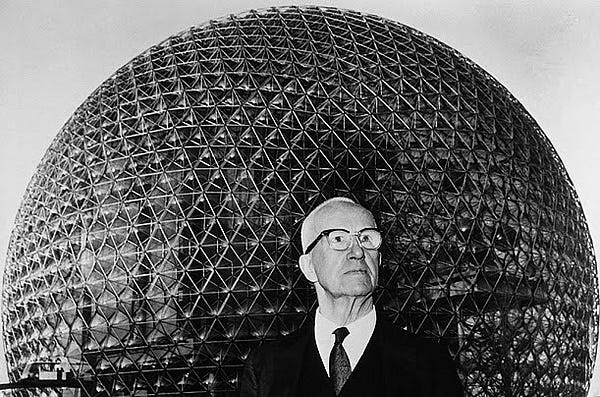
Buckminster Fuller
Whilst we’re at it, take those empty walls, ask who inspires the folks at work there and fill em with pictures. Apparently Ranulph Fiennes was inspired by pictures of explorers on the wall of his family home. Don’t let the images go stale, circulate the images to keep them fresh and put a short description underneath. The department in my head brings pictures of James Lovelock, Heath Robinson, Jony Ive, Mahatma Gandhi, Buckminster Fuller, Petra Kelly and many others to mind. But ask your people and let them bring variety. In a big organisation they could swop occasionally with other departments. On that subject some of their time could be spent in the other department silos. Go forth to shared spaces and communicate. get out more!
Environment done! Getting out more done! What about some personality
So we’ve shaken up the work place and the amount of time spent in it a bit. But we need to bring out the personalities a bit more too. What are we going to do with what we learn from the big outside? Will we discuss it at the end of our rigid formal meeting whilst everyone scoffs? Or will we clear a space in our diaries each day for some informal bumping of ideas?
According to research, 52 minutes is desired as the maximum productive time, but only if we have 17 minutes in between doing something completely off the wall. So let’s use that time for an upload together. Make it a bring and share, bring ideas, learn, read, show videos and put them all to the sword in a public forum. Discuss pros and cons, make it fun. Do this every day. Have expressive space, big whiteboards, pin up spaces etc. People talk about learning and development as though it’s something separate from your work. It should be part of your DNA to learn and take on new ideas and break down old assumptions and do it collectively.
Language and identity
thanks to Pexels.com
This upload forum described above also serves a different special purpose. It begins to attack the assumptions of agreement. It starts to change the dept language. It starts to erode ingrained values and beliefs. It starts to give people personal identities as they emerge from their silos. It can begin to shape how people self-identify. There are swathes of academic writing about identity and I bow to the research of e.g. David Campbell and Ziauddin Sardar. I cannot begin to open this Pandora’s box, but I will say that changing language to suggest activities rather than cultural themes is a good start. Say out loud; I’m an innovator, engineer, creative, environmentalist, maker, writer, photographer. These are positives. Move away from job titles, they’re a bit irrelevant and yesterday. Move away from descriptions like, team leader or manager these are equally unhelpful. Self identity around what you want to do might be nice place to start, e.g. Environmental champion, creative engineer etc. This should become default language, the way you introduce yourself in a speed dating session. A bit like your elevator pitch for yourself. Oh and watch this video it deals with shedding old identities better than I can.
As the language advances and the upload conversations will become more detailed, notions of who do I identify with can come in. Not in a negative way like I’m a facist and all my friends are white supremacists, hell No! More like I’m really into making things, I’m influenced by Michael Reynolds and Geoff ‘Earthship’ Starlington, I like the work of Jony Ive, I follow the philosophy of Buckminster Fuller and Hundertwasser, I listen to Curtis Mayfield and Megadeath. Suddenly each participant in upload develops a personality. Someone recently suggested a bring your personality to work day. Maybe that’s a possible start? Who influences you at work and why? Who influences or inspires you in life and why? What are their values and qualities you admire, have you worked this out? Do you carry this knowledge with you? Do you share it? Go share it now!
So the environment has changed, people are out more and the personalities they bring back begin to emerge now what?
How do we cultivate these changes further?
So identities are not fixed, remind people they can change their nationality, religion, beliefs, gender, sexuality, name, status, geography (urban/rural). All of these cross cutting themes can vary throughout your life! Oh yes they can and do! But try to see people without those labels, it’s really hard and takes practice but it’s worth it. Some organisations manage this, it’s worth taking a long look at them. Ask me for details.
Let’s develop some ideas about culture change a bit more. How are we going to move further together?
Well people can choose their identity and express it and they can choose their actions. They don’t have to conform to organisational assumptions. Move them further, ask them who they identify with? Characters from film or fiction, role models? heroes? Why ask them this? Because I suspect they are a great guide to where people get their ideas and possibly to where they think they’re going, or would like to go. Who influences you? Who do you aspire to be?
How do you want to be seen now, and how do you want to be remembered?
Now we have opened Pandora’s box, we are beginning to change things. People are attempting to express themselves within the new environment and new ideas are forming as a result of the getting out more.
How do we filter those ideas into the work that needs to be done?
Ask questions of each other and ourselves. Why am doing this work? Who else needs to know about it? (Not just the usual suspects our professional partners). Who is working on this stuff as well as me? Originality is very rare, someone is doing your project somewhere else, even fire was discovered in different parts of the world simultaneously. So go find out who you might be able to collaborate, share with, increase value of, learn from. Where shall I go to find out who’s doing this? Can I test it with someone completely different than me? What do I know? Why do I think I know it? What do I want to know? Who’s opinion do I currently value and why? Is that correct?
I’ll say it here and now; it is sharing information that is powerful not keeping it to yourself!
thanks to Pexels.com
Once we work together, we need to create a vision. At present we are here. Where do we want to be? What will it look like? How will we behave? Describe ourselves and the organisation? What will people see, hear, feel when they come to see us? Once you’ve built, collected, asked, advanced, changed the environment you work in. And the way you work, got out more, questioned yourself and others. The culture will begin to change and it will show.
Ponder this scary thought, you’ve changed the culture, collectively and individually. When you finally put your ideas up there, what does it feel like? Ask any artist, writer, film maker, songwriter. Very scary but really exciting. It will be challenging or beautiful but not passive!
So what about habits?
Question: What about habits what have they got to do with it? Habits become what we wear, where we work, how we describe things, what we eat, what we read, the cafe we drink our tea at, the tea we drink (coffee in my case can’t stand tea, was an avid Earl Grey drinker then I stopped and drank coffee instead) our work patterns, how we describe ourselves, how we relate to others. The things that shape the assumptions that lead to the culture of an organisation come down to habits.
Individual habits and they can change. They are the elements of a culture and they are a choice.
Some people say that they are part of our personalities. But if you vary habits and break patterns it can lead to unexpected benefits and adventures and enhanced wellbeing. Imagine the thrill of watching a different soap opera. Get into new characters in a book. Or read different news, possibly with widely varied or opposite views to the ones you habitually follow. Scary but enticing territory. I watched horror films for a while found them challenging and jarring. I went back to my safe zone of crime, but I never quite viewed it in the same way again. I really began to understand why I liked it so much more than horror.
Back to work and culture
Do you wear a suit every day? Or wear one occasionally? If you never do maybe you should. How about you never wear the same twice in two days. Perhaps people will enjoy a guess and wonder what you might wear next. Then go sit in a different place, pick a silo elsewhere. Ask them questions about or related to your work and theirs. People are flattered by questions. Organise a non-traditional meeting, read up on how to do it. Or ask me for help. Yes you can do all of these things in the same day, after all isn’t variety the spice of life?
Change your language, describe your role and yourself differently when asked. Invent a new persona at work, be who you really are. Present your work as you. Ask for critique in a constructive way, or combative if you dare! You’ll never be the same again. Programme your work in a pattern, 50 mins head down, 20 doing something radical. Go work elsewhere, invite others in! Mix your meetings up. Bring in outsiders (shock horror) Let the washing machine engineers meet the fashion designers and together they can design a new car. Read this brilliant article on collaborative culture by Rosie Manning Oh and just read more, its like learning and development only more enjoyable. here’s a great guide to how and why.
Set the scene, take 2
In my mind I walk into the dept, it’s a hive of activity, individuals work here. I know that because no two look alike. They’re in groups or silos huddled together hard at work. Another group are around a display board. They discuss an idea, it’s a challenge to get a word in. When I do I’m accepted, they listen to and record my contribution. The silos break out into a hive of activity. The meeting i attend is brisk, it has objectives and outcomes. People only come in when they’re needed. Not all of the orchestra plays at once! I take actions with deadlines so do others. There’s an acknowledgment we will complete them on time.
A walking meeting passes by deep in conversation. I notice staff have adorned the walls with interesting images. I ponder them whilst I drink my coffee. I go to a different dept and ask what their images are all about. For the next fifty minutes I write my next project overview. I take it out to the display board, colleagues and visitors gather to discuss it, not a suit or tie in sight. The odd pointy shoe here and there and some decent beards but I ignore that and view them as people. I record all of their views and ideas verbatim, they help gel and confirm some of mine. Some are radically different. I make a note to test them against my assumptions.
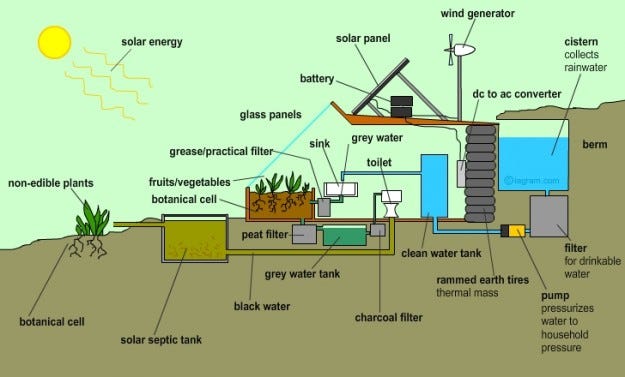
Borrowed Earthship diagram
I’m off now to work in the DeskLodge Bristol now (or any other co work space you’d like to imagine). I know it’s full of creatives today for a conference. I’m Going to stay for the evening discussions. I will show them my project, I’m scared but excited. Work will never be the same again. I get up excited to cycle in. I’ve got a picture of an Earthship in my bag I’m thinking about building. I want to know what people think, how they would improve it. Tomorrow I’ll work at the science park, see what they think of my latest project. Will it stand up to their scrutiny or will I need to rethink. it feels exciting when I put myself out there. I’m hoping for something innovative. if nothing else it’ll be a challenge, it may be beautiful.
If you want to change your organisation, change the culture. If you want to change the culture change the habits. If you want to make it more diverse, stop trying and change the above two.
NB. I’ve tagged some books and articles I’ve enjoyed, there’s a wealth of research done on this topic too great to mention here. This is simply a blog of my thoughts not an academic paper. Go read more it’s fun! If you want help doing things different ask me.
This blog is also on Medium: https://medium.com/@JoeKBaker/changing-culture-not-easy-but-the-prize-is-huge-dd3ed1f65a4d#.ydcreodzm
But, always figure out who is doing what to whom in any story. Then you can look at where you fit in. Make sure that it's right. #joesmantras
its interesting to me that I watch stories unfolding on a daily basis and I see the events that unfold. What I see is that people involved in those stories, sometimes even key actors, don't know where they fit in. They don't see what their part is, if any. They don't anticipate where to come in and when not to. They definitely don't realise that the plot is unfolding around them. They are unaware of the possible outcomes.So be aware, ask why you're invited? What is your part in this scenario, project, adventure? Do you have to play all the time or can you just come in when you're needed?
Running a good project is a bit like conducting and orchestra. Not everyone needs to play all the time. Bring them in when necessary. Don't involve them at every meeting they'll quickly get bored. Most scenarios I witness have too many players altogether. They play too often they all come in at once and they don't have a clue where they fit in. Often it's my job to sort this out. I ask why are you here? Do you have the time and permission if you need it? when and where does your bit begin and end? How would you like to be kep informed? An oh yes here's the script and timings (plan) to enable you to know theses things. I'll be in touch....
A few years back I was speaking about using social media in a crisis at a CIPR conference. During the course of that talk I coined one of my favourite mantras: "publish once broadcast widely" (I have quite a few). Interestingly I've heard this coming back at me a number of times since, which in many ways is quite gratifying. The difficult bit is some people have misinterpreted it. So to clarify, in a crisis you have one landing page or site on which you publish all relevant and important updates. Then you use all channels available to you to link back to the landing page. You then set about actively discouraging anyone who takes the information and re-interprets it. You persuade them to link back to the original text on your landing page.
Many of these are also on Meetup.com Download the app if you have a smartphone Please comment on this blog with any I've missed and I'll update and add to the post. Hopefully it'll become a useful source of reference. Happy Geeking!
As a result of the excitement of my Streetsmart Beautiful
map team coming second in Exeter's first startup weekend. I've reflected on the event.
The Beautiful Map Team
First off I have to say the organisation and facilitation of
the weekend was super good! The innovation centre aids this by it's modern
feel. it encourages collaboration by being bright, open and airy. There was
plenty of everything you needed to keep[ you going for 54 hours. The food from Pickle Shack was exceptional
I learned so many things but I will begin with my personal
thoughts. I went to the event with a
blue sky idea about mapping locations. Which I named Streetsmart for the event.
I had great reservations about pitching. Although I've presented many times and
spoken at conferences. I realised putting your own idea out there is very different.
The pitch process is quite an experience. Everything hangs on the 60 second
initial pitch that gets your idea in the running. Fortunately enough people
voted for my initial pitch. So we formed a self selecting team to have a go at
tackling the problem. Winning or losing depends upon the five minute pitch.
Final 5 Minute Pitch
This lets the judges decide whether your team has met the scoring criteria. The
key to both pitches is following startup weekend pitching structure (more
later). in fact once you've learned this structure it's the key to organising
your weekend. I was delighted that we achieved second place. I learned for
myself that my ideas are as valid as anyones.
And my beloved small project way of working where people cluster around
a subject really works! That was such a personal validation for me!
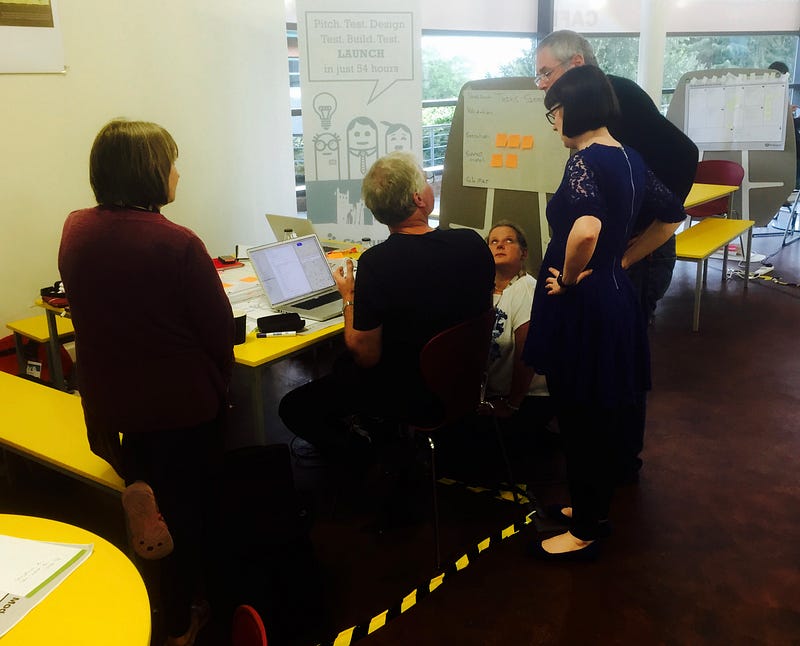
Team Check In
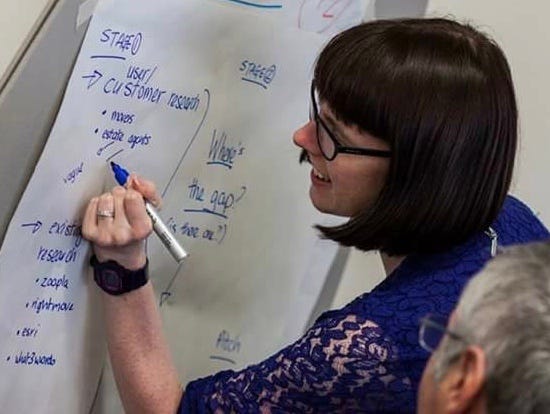
Once you're selected as a project to work on then you form
teams. This was awesome in that the teams were self selecting. I was
exceptionally lucky to have a team of committed players. Who all contributed
their skills and ideas. There's something special that happens when people like
a project and they gel it's very exciting.
There were moments of stress but also great humour and humility too. The
whole team were lovely people and I hope they got as much from the experience
as I did. it may not seem much but 54 hours of focus on one thing is
exhausting. I was very grateful for Monday off! (that's tip no.1)
So my event learning in no particular order:
It is possible to pitch a completely blue sky idea
But research on competition and refining your MVP will help
The initial pitch really matters it gets you in the running
Your initial pitch is also your lobby for team members so make
it appealing
Small committed teams are ideal
Know the times of everything and put them in your plan
Schedule team check ins so that you don't have to disturb
everyone
Coders need a quiet corner away from the hubub
Plan to fit the final pitch structure: MVP, validation,
execution, business model (include marketing)
Decide your MVP minimum viable product early on day 1
Go out and validate your idea (you could do this before the
event)
Come back and refine it, often redefines your MVP
Learn the judging criteria and work according to this
throughout
You can do the whole thing in a weekend but do most of your
work on day 1
Pitch practice takes up a bit of day 2 so get your structure
right early on
Take regular breaks and have fun
Network and make the most of the skills in the room
I'm sure the rest of the team can add many more things to this list. I can't say enough how much I enjoyed this weekend. Flexing my brain with really nice, smart people in a fab venue what could be better. I would strongly reccomend this weekend to anyone thinking of starting something up. The next one is on November 20th. See you there!